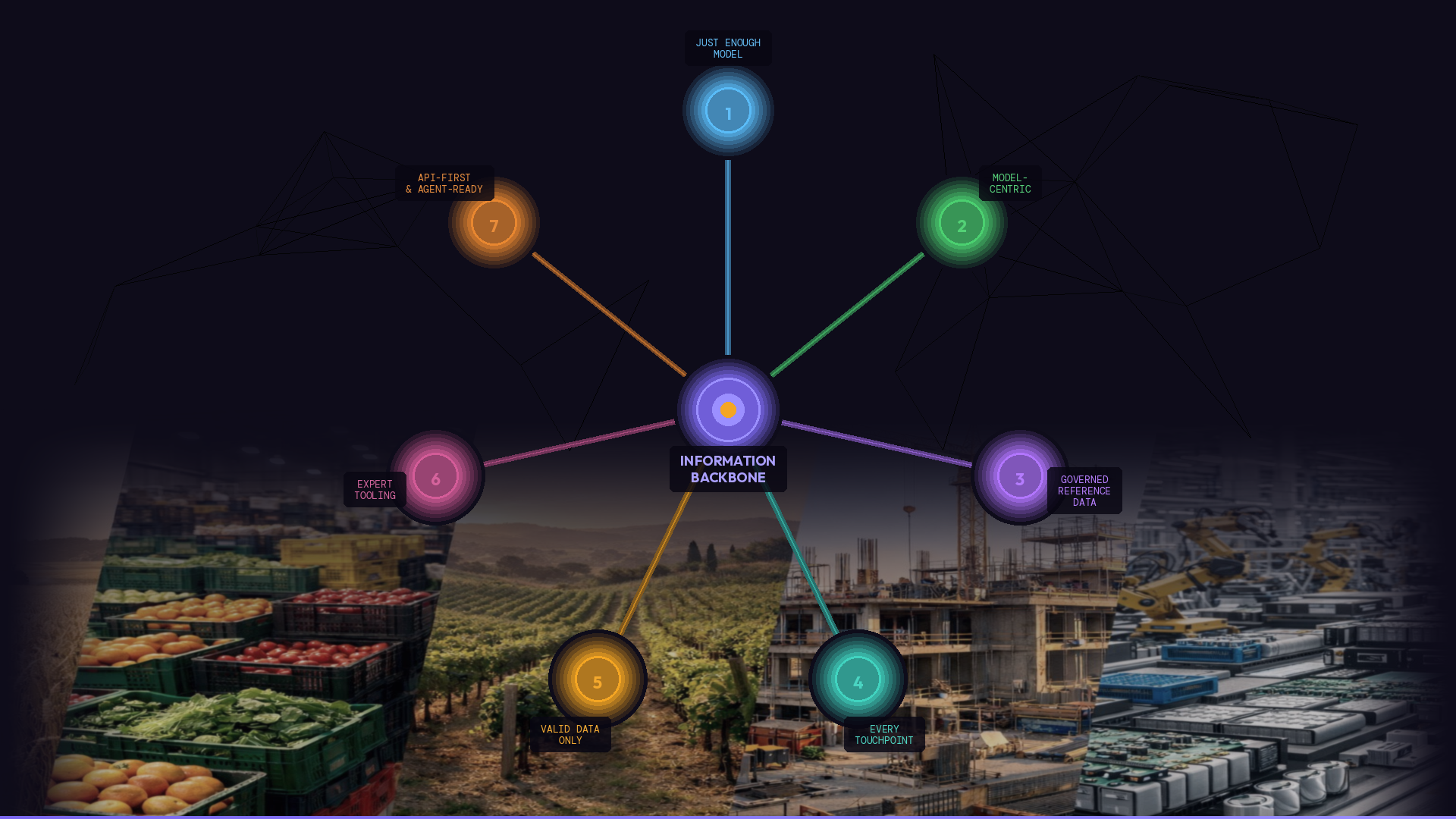
Gartner has spent 2026 telling data and analytics leaders that context is the brain for AI, that universal semantic foundations are non-negotiable infrastructure, and that most enterprise AI agent systems will be built on context graph foundations by 2028.
In short: Agentic projects that rely on connectivity alone, without a consistent semantic foundation, will fail.
Readers of this 'information backbone' series will recognize the argument. Machine readability is a meaning problem, not a format problem, and the answer is a governed information backbone. What Gartner calls an AI context platform, a context graph, or a universal semantic layer describes the same pattern.
For a COO or CIO acting on this, a practical question follows: when you look closely at a real semantic backbone, what should you see? The answer comes in two parts. Two of the seven characteristics are design disciplines - decisions your organization makes, which no vendor can sell you. One, reference data, sits at the joint between the two. The other four are platform capabilities - things the technology either provides or does not, which no amount of internal discipline can substitute for.
Bottom line up front:
A real information backbone - the platform behind what Gartner calls AI context - is defined by what it enforces, not what it stores. Two of its seven characteristics are design disciplines your organization must bring, one sits at the joint between design and platform, and four are capabilities the platform must provide.
The design disciplines: driven by what you will ask of your backbone
1. Your model embodies just enough, and only what’s required. The model is scoped deliberately - only the entities, relationships, and classifications your domain actually needs in order to serve its purpose, and nothing more. Drive this by framing the questions you will ask of your backbone. If you try to model too much detail in your target domain, you will fail due to excessive governance overheads that lack corresponding value payback. This is a scoping decision your organization owns; the best platform in the world cannot stop you boiling the ocean.
2. Meaning is defined in the model first. The data model is more than just an implementation detail - it is the central thesis. Every data type is defined, every relationship expressed in a form humans and machines can read and reason about. Context must not be left to interpretation, and machines must not be left guessing at query time. When Gartner says context must be machine-readable to serve agents, this is what that means in practice: the meaning lives in the structure, and putting it there is design work that precedes any implementation.
Design discipline and platform capability
3. Reference data is designed into the model and governed by the platform. Reference data sits at the joint between your design and your platform. Where it fits is a modeling decision: which properties draw from controlled vocabularies, which classification schemes attach where in the schema, and which external standards earn a place. Whether it stays governed is a platform question: ownership, propagation when a standard changes, translations, synonyms, and tooling usable enough so that SMEs can enjoy curating and maintaining the vocabularies. An unsuitable model will waste good reference data tooling, and a poor platform will ruin the potential of good reference data design.
The platform capabilities: what to demand from the technology
4. The model is available at every touchpoint. The platform makes the model the authoritative source of meaning wherever information is created, consumed, or exchanged - a subject matter expert entering data, a regulatory system submitting a report, an AI agent processing a query. Context that is only available in one place is not context infrastructure.
5. It accepts only valid data. Governance means enforcement, not just definition. A platform that admits invalid classifications, loose data typing, undefined relationships, or out-of-vocabulary values will fail you here. Validation at the point of entry is what keeps the context governed.
6. It gives SMEs tooling that follows the model. Subject matter experts - not IT teams - are the custodians of domain meaning, and the tooling must reflect that. SMEs should populate, validate, and evolve the information directly, without having to raise a ticket, or wait for resources from a central team. A context platform that only engineers can maintain will inhibit product delivery speed, and will drift behind the reality it is supposed to describe.
7. It is API-first and agent-ready. The platform is designed to be consumed. Its APIs expose governed meaning - not just data fields - so every system, AI tool, and agent draws from the same verified foundation. This is the characteristic Gartner’s agent predictions depend on: an agent reading from a governed backbone is reading verified meaning, not guessing.
Why these seven characteristics are important as a checklist, right now
When an analyst firm names a category, vendors reposition toward it. Right now, and increasingly over the next year, data catalogs, metadata managers, and document stores will be describing themselves as context platforms. Some will have the architecture underneath, but many will not.
The two-part structure gives you a way to check both sides of the deal. The capability characteristics are testable in a demo or a proof of concept: a platform that stores context but does not enforce validity fails characteristic five; one whose model only engineers can touch fails characteristic six; one that exposes data fields rather than governed meaning fails characteristic seven - and with it, the agent-readiness the category is named for.
The discipline characteristics are a different kind of test, and they point at you. A vendor selection process that has not answered “what is the minimum model that serves our purpose?” is not ready to evaluate platforms, because it does not yet know what it is evaluating them for.
Simple Steps for COOs
- Test the four platform capability characteristics in a demo. Ask to see the validation reject bad data. Watch an SME update the model and test it with real data, without an engineer involved. Check whether the API carries the model - the relationships, classifications, and governed meaning - or just the values. If a vendor cannot show you all three, keep looking.
- Settle the two design disciplines before you shortlist. Define the specific questions your backbone must answer, sketch what your minimum model looks like, and identify the reference data you will need to govern. Have that conversation with candidate vendors before the formal evaluation begins. It will make the selection faster and the outcome more predictable.
- Ask what the platform enforces. The value of a context platform is in what it refuses to accept and what it guarantees to every consumer. If the answer to "what happens when someone enters an invalid classification?" is "we recommend training," keep looking.
This post is part of The COO's Machine-Readable Information Backbone series.
Next in this series:
Post 8: EU Digital Product Passports - a go-to-market opportunity, not a compliance race. This regulation mandates the minimum, and your information backbone makes everything beyond it affordable.
Post 9: How to build your context foundation without boiling the ocean - Gartner says invest in the next 6-18 months. Here is how to do that without an eighteen-month program.
Previously in The COO's Machine-Readable Information Backbone series:
Post 6: AI observability in high-trust environments - if your AI outputs cannot be checked against a governed reference, you do not have observability. You have review. And in high-trust environments, review does not scale.
Post 5: The quiet power of reference data - governed, shared reference data is the stable vocabulary your backbone speaks in. Without it, every system downstream is guessing.
Post 4: What is an information backbone? A plain-language definition for operational leaders - written for organizations that already have systems, already have data, and are still asking why none of it feels reliable.
Post 3: Why AI needs a governed information backbone - not just better prompts - in regulated and high-trust environments, AI reliability is not a model problem. It is a foundation problem.
Post 2: Machine-readable information architecture is better for your people too - better information foundations improve the experience of the humans who work with product data every day.
Post 1: What does "machine-readable" really mean for digital product labels? - machine readability is a meaning problem, not a format problem.
Also in this series: Build or buy your information backbone? - why the true cost of building a governed information backbone is almost always underestimated.