
Ask a general AI assistant a deceptively simple question: “Compare the match minutes played by every England and Argentina player across their runs to the World Cup semi-final.”
Google’s Gemini does not attempt it. It gives impressions, not numbers. And that is expected: it has no structured representation of the tournament. It is doing next-token prediction over unstructured text, so counting, negation (“who did NOT start”), and aggregation across matches are all out of reach. Similarity search finds what resembles your question. It cannot compute over a set it does not hold.
We asked our own Data Graphs AI the same question, running over our World Cup knowledge graph. It read the schema, wrote GQL against the graph, pulled every player’s participations, minutes, and the substitution events tied to each goal, and aggregated across all six matches. Exact figures, in seconds. Same class of underlying language model. Completely different outcome.
The difference is not the model. It is the context.
What we built
Throughout the tournament we have been ingesting the full FIFA World Cup data feed from SportMonks: player stats, team stats, match stats, and every in-game action and event. All of it is modeled in Data Graphs using the IPTC Sport Schema, giving us an extremely well structured sports knowledge graph where players, teams, fixtures, lineups, substitutions, and events are all first-class, connected entities.
On top of that graph sits the Data Graphs Agentic AI layer, exposed through native MCP tools. The AI agent reads the domain schema first, so it has a total semantic understanding of the data: what a lineup is, how a substitution relates to minutes played, how a fixture connects to a tournament stage. From there it writes and runs precise graph queries to answer questions no general assistant can touch.
What the data showed
We asked it to compare match minutes for England and Argentina across their six-match runs to the semi-final. The chart below came straight from the analysis.
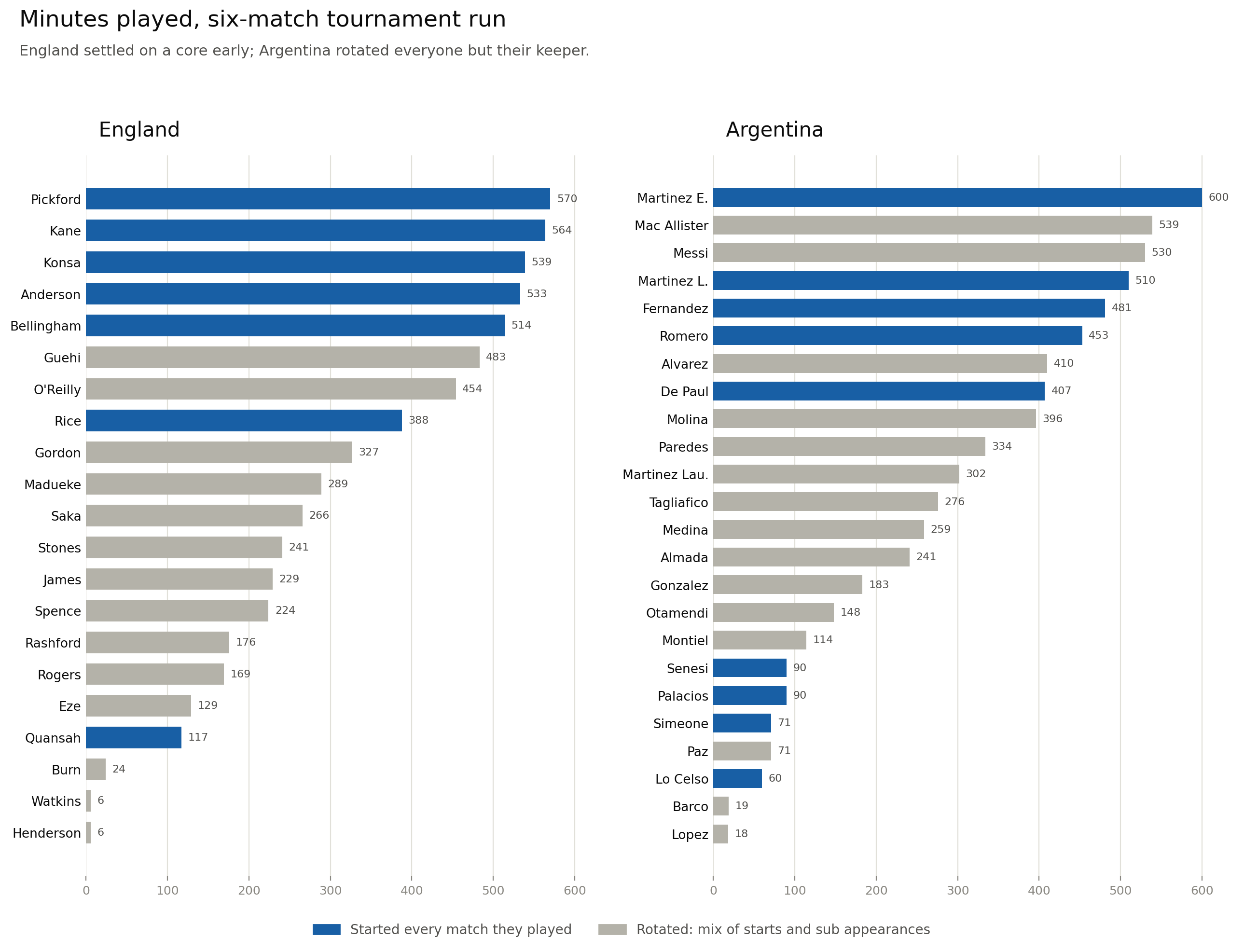
The headline findings:
England’s core was far more settled. Five players started every match they played and were on the pitch almost throughout: Pickford, Kane, Konsa, Anderson, and Bellingham. Argentina had just one ever-present, Emi Martinez, who played all 600 minutes.
Argentina used more of their squad. 24 players got pitch time versus 21 for England, with several getting a single substitute appearance.
Argentina rotated starters more aggressively. Only Emi Martinez was untouchable. Everyone else was rested or rotated at least once, including Messi and Mac Allister.
England leaned on impact subs. Saka made six appearances but only two starts. Djed Spence, the same. Regular contributors, rarely in the starting eleven.
The tactical contrast is striking: Scaloni’s proactive, pre-planned rotation, swapping pairs around the 55th to 65th minute regardless of scoreline, versus Tuchel’s situational, reactive adjustments based on how each match unfolds. Both approaches have delivered results, but Argentina’s bench has been more consistently decisive, with 67% of their goals coming after substitutions versus 45% for England. England’s subs have not really fired yet.
Why a general AI cannot do this
None of the analysis above is complicated math. It is counting minutes, starts, and substitute appearances. What makes it impossible for a general assistant is that the answer requires:
- Complete, structured data. Every lineup, substitution, and event for every match, connected and queryable.
- A shared semantic model. The AI needs to know what “minutes played” means in terms of lineups, kickoffs, substitutions, and stoppage time. The IPTC Sport Schema encodes that meaning explicitly.
- Tools to query it. Via MCP, the agent reads the schema, understands the domain, and executes graph queries against governed data rather than guessing from training data.
The post-substitution goals stat is the tell. “Goals occurring after a substitution event” is a graph traversal: goal to match to substitution, a time comparison between events, aggregated and expressed as a ratio. There is no embedding for that. It is a query, and it only works because the relationships are modeled explicitly and typed.
This is the difference between retrieving text about your data and reasoning over your data. Vector search is great for the former. For the latter you need a graph. A general AI has a probabilistic memory of the web. Our agent has a knowledge graph.
This is not about sport
Football is just a vivid demonstration. The pattern is universal: take a well modeled domain, put it in a knowledge graph, expose it to AI agents through a semantic layer and MCP tools, and questions that were previously unanswerable become routine.
Swap players and matches for products and suppliers, clinical trials and outcomes, regulations and obligations, assets and rights. The same architecture applies. Your data, modeled on your schema, queried with precision, with governance and permissions enforced at the point of query.
That is what Data Graphs provides: the semantic context layer for Agentic AI. General models supply the reasoning. Your knowledge graph supplies the truth.
If you want to see what your AI could answer when it actually understands your data, get in touch at datagraphs.com.