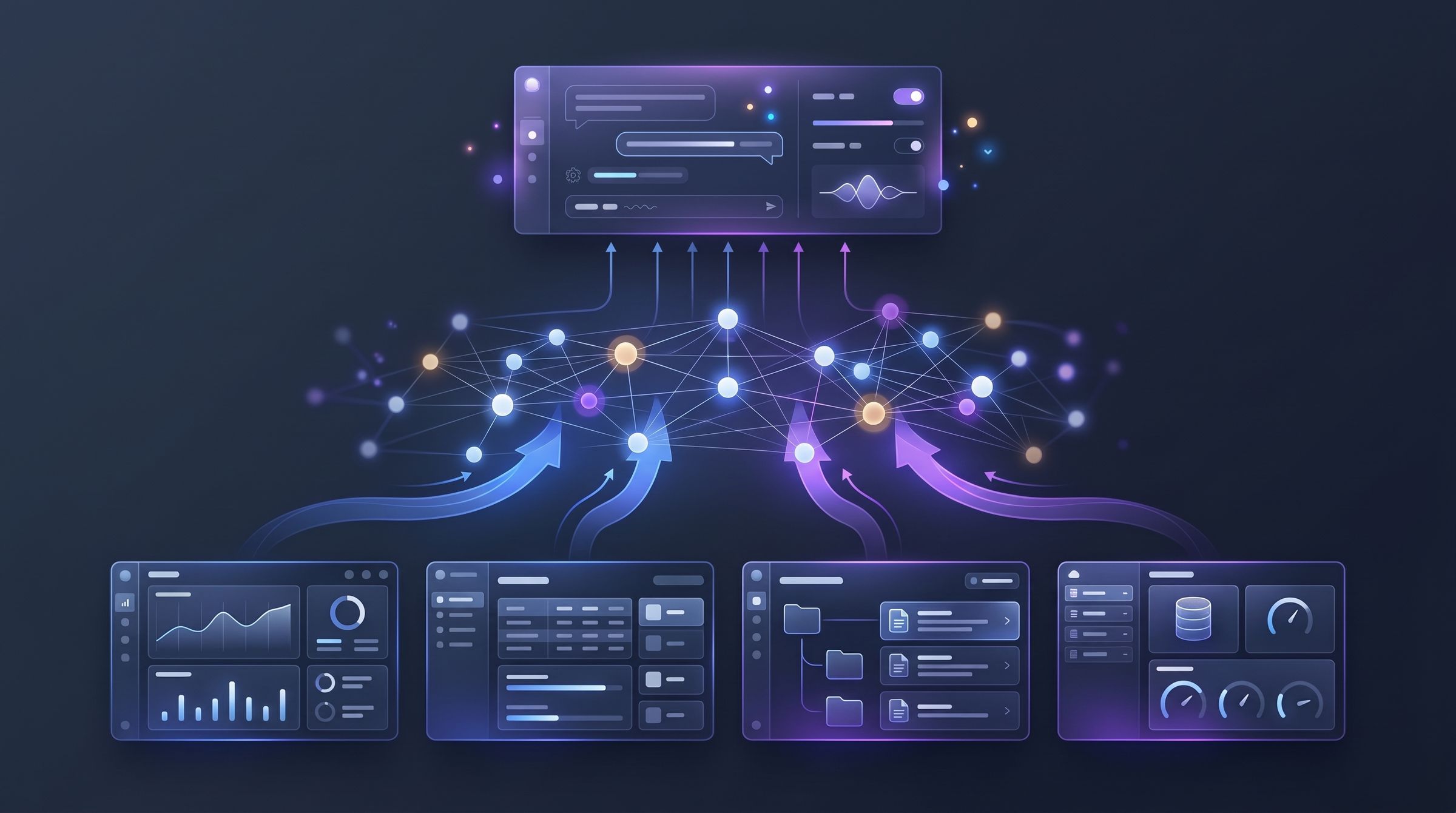
A context layer sits between your systems of record and your AI applications. It gives agents a governed description of your data and the tools to query it accurately.
From our work building Data Graphs, we see five key capabilities as essential. This post covers each one and how Data Graphs implements it.
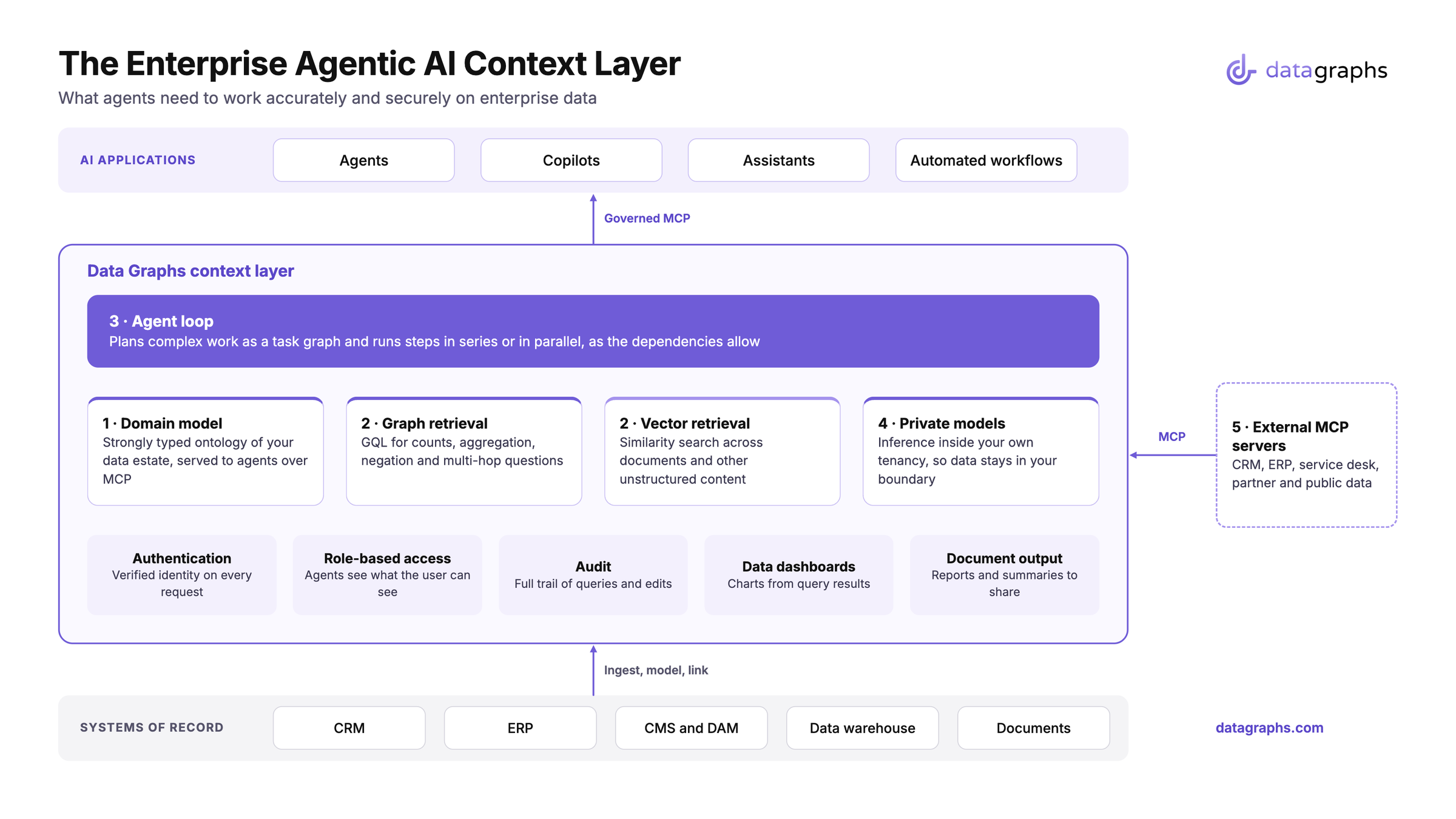
1. A strongly typed domain model, served over MCP
Your domain model is the classes, properties, relationships, data attributes, and controlled vocabularies that describe your data estate. When it is cohesive and strongly typed, an agent can see, for example, that a Supplier supplies a Component, that a Component belongs to a Product, and that a Product carries a Certification with an expiry date.
Expose that model to agents over MCP as their primary semantic model so they can plan queries against real data. Grounding then improves and hallucination drops (typically to zero), because every query is planned against the actual data structures across your business.
In Data Graphs, you model your domain either programmatically or visually and the platform serves it to agents through native MCP services. The engine combines graph query (OpenCypher and ISO GQL) with RDF/OWL-style ontology semantics, so the model is both queryable and machine-readable. Governance, permissions and business rules apply at the point of query.
2. Vector and graph retrieval, with skills that guide query building
Agents need vector and graph retrieval because each answers a different class of question.
Vector retrieval is the right tool for unstructured content: documents, emails, reports, free text. It finds content that is semantically close to a question. It struggles with empirical questions. "Which suppliers have no valid certification?" needs negation. "How many product sales above $X last quarter?" needs counting and aggregation. "Which products depend on a component from a sanctioned region?" needs a multi-hop traversal. Embeddings have no geometric representation for any of these.
A graph (or SQL) query answers them exactly. Agents build efficient graph queries when they know the schema and the query patterns that perform well. Skills supply the packaged guidance that tells the agent when to use vector, when to use graph, and how to compose an efficient query for the model it is working against.
Data Graphs runs hybrid GraphRAG over both GQL and its built-in vector index, on top of a Rust graph engine that is exceptionally fast, low-latency, and keeps query time near-linear as graphs grow deeper and broader.
3. An agent loop that runs serial and parallel task graphs
Tasks such as reconciling a supplier list against compliance records, drafting a product passport from a dozen source documents, or answering a question that spans three systems break into steps with dependencies.
The agent loop should plan that work as a task graph. Independent steps run in parallel, each with its own focused context. Dependent steps run in series and receive the results they need. The loop then assembles and checks the output before it returns.
This keeps each agent's context small and relevant, reduces time-to-answer, and makes the reasoning traceable step by step. Data Graphs' agentic layer orchestrates these task graphs across its own retrieval tools and any additional MCP tools you configure.
4. Models that run on your data, inside your boundary
A context layer concentrates your most valuable data in one governed place. Agents invoking remote frontier models (Claude, ChatGPT etc) send some or all of that data to the provider with every query, outside your organizational boundary.
Running inference close to the data avoids this: private or controlled models running inside your own cloud tenancy or infrastructure, with no data leaving the boundary you control. For regulated sectors this is often the deciding factor.
Data Graphs can run as a managed service or deploy directly into your own AWS tenancy, and its Graph retrieval layer feeds governed context to private and controlled models.
5. External MCP servers as first-class tools
Enterprise data is spread across many systems. Customer history lives in the CRM, orders in the ERP, tickets in the service desk, and some answers need public or partner data.
The context layer should let you plug external MCP servers straight into the agent's toolset. The agent then combines your governed graph with live data from those systems in one task graph: pull an account from the CRM, traverse its product and contract relationships in the graph, and summarize risk from the related documents.
Data Graphs supports configurable MCP tools in its agentic layer, so any internal or external MCP server becomes available to your agents alongside graph and vector retrieval.
Other enterprise essentials
The five capabilities above cover how agents understand and query your data. An enterprise deployment also depends on:
- Authentication. Users and agents authenticate before they reach any data, and every request carries a verified identity.
- Role-based access control. Permissions on data and tools follow the user's role, so an agent acting for a user sees only what that user is allowed to see.
- Audit. A full trail of queries, edits and workflow events, for compliance and for tracing how an agent reached an answer.
- Data dashboards. Agents generate charts and dashboards directly from query results, so answers arrive in a form people can act on.
- Document output. Agents produce reports, summaries and other documents from governed data, ready to review and share.
Bringing it together
Together, these capabilities give agents a typed model of your data, the right retrieval tool for each question, a way to break down complex work, private inference, access to the rest of your systems, and the security and output features an enterprise rollout depends on.
Data Graphs supports every capability in this post in one platform, from the strongly typed domain model and hybrid retrieval through to authentication, role-based access, audit, dashboards and document output, built around our own high-performance graph engine. If you are building agents on enterprise data and want to see it on your domain, get in touch here.