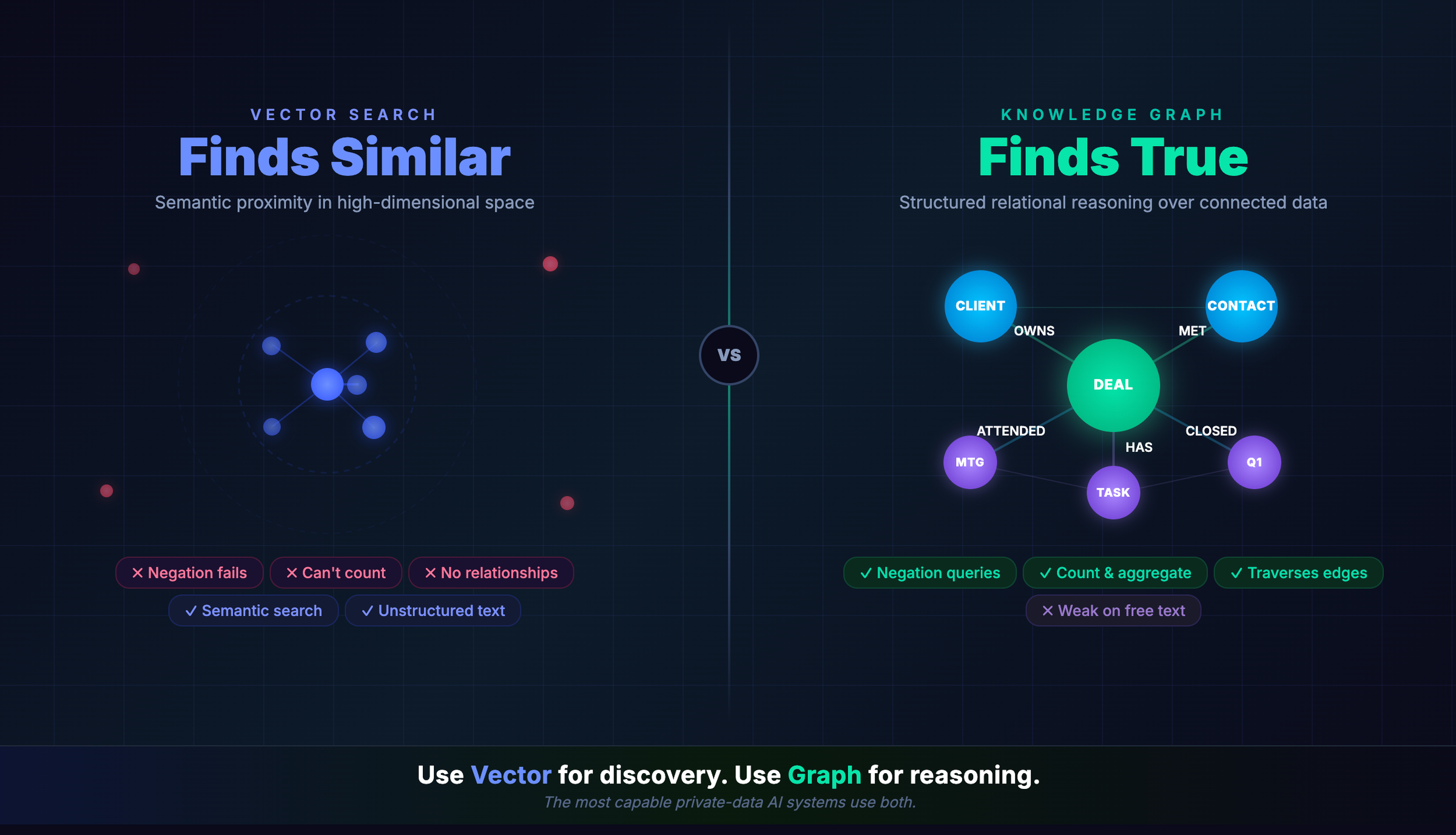
Most RAG implementations default to Vector search. It's fast, it's easy to set up, and it works brilliantly for finding semantically related content.
But if you're building an AI assistant that reasons over your private data: your calendar, your CRM, your communications - vector retrieval alone will quietly fail you. Here's why:
❌ Negation doesn't exist in embedding space. Ask "Which clients haven't received a follow-up this quarter?" and a vector store will return clients who have because similarity search finds what's present, not what's absent. There's no geometric representation for "not"
❌ Aggregation and counting break down. "How many deals did I close in Q1?" or "What was my team's response time on high-priority tickets last week?" require structured traversal and arithmetic - not nearest-neighbour lookup. Vector retrieval simply wasn't designed for this.
❌ Relationships are invisible. A vector store holds chunks of content. It doesn't model the connections between a contact, a company, a meeting, a contract, and an outcome. Yet those edges are often exactly what you need to answer a business question.
❌ Precision degrades as data grows. The more private data you index, the noisier vector retrieval becomes. A knowledge graph though, can continue answering precise structural questions regardless of scale - because it's querying a graph, not ranking similarities.
The real insight is that these two approaches are COMPLEMENTARY, not competing:
→ Vector is exceptional for unstructured semantic search - finding the right document, summarising meeting notes, surfacing relevant emails.
→ Graph is exceptional for structured relational reasoning - answering questions about who, how many, which didn't, and what changed.
The most capable private-data AI systems will use both: vector for discovery, graph for accurate reasoning.
If you're architecting a RAG pipeline on enterprise or personal data and you're only using vectors, you're leaving a significant chunk of the possible answer space on the table. Get yourself a Knowledge Graph as well ! 💥